How to Build a Viral Waitlist That Grows Itself
A viral waitlist isn't luck — it's mechanics. Here's the complete guide to building a pre-launch referral waitlist that compounds on its own, from the landing page to the referral engine.
Every viral waitlist looks like magic from the outside. A founder posts a link, it gets shared thousands of times, and the signup count climbs by itself. From the inside, it's almost always the same mechanics: a clear promise, a referral incentive that creates genuine urgency, and a product category that people want to talk about.
You can't guarantee virality. But you can build the infrastructure that makes it possible — and most founders never do, which is why most waitlists plateau the moment the founder stops manually sharing them.
This is the complete guide to building a viral waitlist: the landing page, the referral engine, the incentive structure, and the distribution strategy that turns a flat list into a compounding one.
What Makes a Waitlist Go Viral
A waitlist goes viral when the person who signs up has a reason to share it with someone specific in their network. Not a vague "this is cool" impulse — a specific reason.
The classic mechanism is position-based referral: sign up now and your spot in the queue moves up every time someone you refer joins. Robinhood used this to go from 0 to 1 million signups before launch. Superhuman used it to create exclusivity. Morning Brew used a variant of it to grow to 1.5 million subscribers.
The psychology is straightforward: people share because they get something tangible — not a t-shirt, but a better position in something they already want access to.
A referral waitlist isn't a trick. It's a feedback loop. People share because it helps them. Their sharing grows the list. A larger list creates more social proof. More social proof increases the conversion rate for new visitors. Which generates more people with a reason to share.
The Landing Page: Three Elements That Determine Conversion
Your landing page is the engine room of the waitlist. A beautiful but unclear page converts at 3%. A plain but precise page converts at 20%. The difference is entirely in three elements:
1. The Headline
You have five seconds. The headline must answer: what is this, who is it for, and why should I care right now?
Bad headline: "The future of project management"
Better headline: "Project management built for solo founders who hate Jira"
The more specifically the headline describes the person reading it, the higher it converts. Target one customer, not everyone.
2. The Problem Statement
One paragraph, below the headline. Not features — problem. The reader should feel recognized: "Yes, that's exactly what's been frustrating me."
If you can describe the problem with more precision than the reader could describe it themselves, you've earned their email address.
3. The Call to Action
The CTA should reflect the referral incentive: "Join the waitlist — move up by referring friends" is more compelling than "Sign up." It tells the person exactly what they're agreeing to and why acting now matters.
Waitflow handles the full landing page build with customizable templates designed around these principles — you provide the copy, the structure is already optimized.
The Referral Engine: How to Build It Right
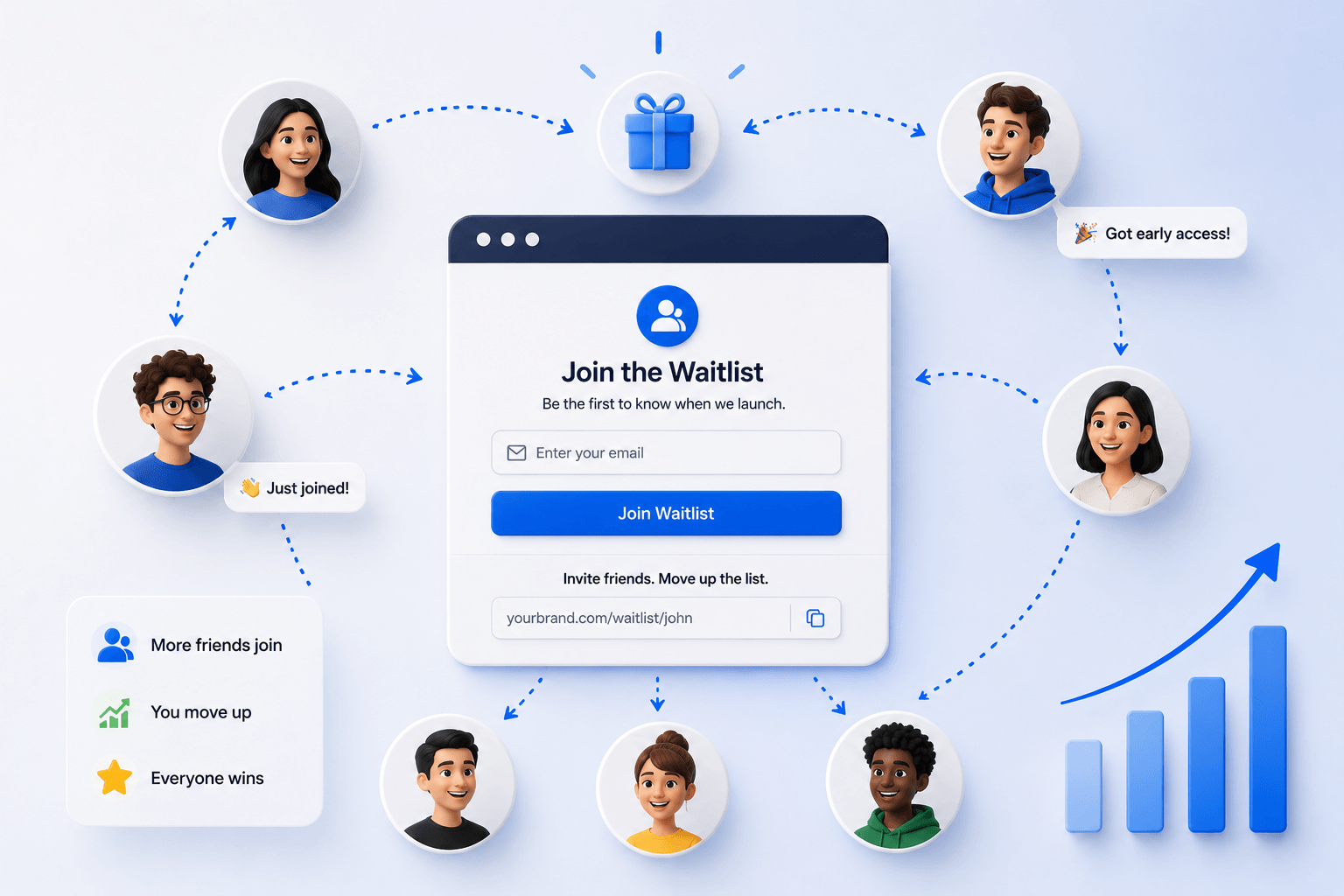
A referral engine has four components:
1. Unique referral links — Every signup gets their own link automatically. Sharing it is zero friction: they copy it from the confirmation page and send it anywhere.
2. Position tracking — The user can see their current position and how many referrals they've made. Visibility creates engagement. Invisible progress doesn't motivate.
3. The confirmation page — This is the most underrated part of the waitlist flow. The confirmation page is shown immediately after signup, when intent is at its highest. This is where the referral link should be front and center, with a direct ask to share.
4. Referral notifications — When someone uses your link to sign up, you should email the referrer. "Someone just joined using your link — you moved from #342 to #341." That notification re-engages people who have forgotten about you and reinforces the loop.
Waitflow builds all four of these into every waitlist by default. The referral link, the position tracker, the confirmation page, and the notification emails are all there — you don't build anything. You just write the copy.
The Incentive Structure: What Actually Gets People to Share
Position-based referrals work because they're self-reinforcing. But the type of position matters.
The "move up in line" model works best when there's genuine urgency about early access. If your product has limited beta slots, a waitlist position means something real.
The "unlock a tier" model works when you have distinct reward levels: "Refer 3 friends and get free Pro access for 6 months." This works for SaaS tools where the product itself is the reward.
The "social proof" model — showing the current total signup count prominently — works when the idea is already exciting enough that people want to be part of the movement. "Join 4,200 founders waiting for access" is a different psychological trigger than a position number.
You can combine these. A waitlist that shows both a position number ("You're #872") and a social count ("Join 4,200 others") and offers a tier reward ("Reach the top 100 to get 6 months free") has multiple incentive layers.
Distribution: Getting the First 100 Signups
A referral engine multiplies what you have. It doesn't create something from nothing. You need the first 50–100 signups to seed the referral loop.
The most reliable playbook for cold launch distribution:
- Share in one relevant subreddit — not a general startup subreddit, the specific community where your target user hangs out. Lead with the problem, not the product.
- Post to your personal network — once. Don't spam, but a single genuine post reaches people who trust you and are likely to share with relevant contacts.
- Post to a niche Slack or Discord — most communities allow product launches in a designated channel. Find two or three where your target audience is.
- Write one piece of content about the problem — not a product announcement. A blog post about the problem you're solving that links back to your waitlist captures SEO traffic and positions you as someone who understands the space. Pre-launch content that validates your idea is one of the highest-leverage activities before launch.
After those four, step back and look at your referral rate. If it's above 20%, keep the same channels. If it's below, try different channels before assuming the idea is the problem.
The Product Hunt-Style Waitlist
Product Hunt's model — a ranking system where community votes determine visibility — teaches an important lesson about waitlists: social proof compounds.
The products at the top of Product Hunt get more clicks because they're at the top. The products at the top are at the top because early voters gave them initial momentum. The same dynamic applies to pre-launch waitlists.
A product with 200 signups that prominently shows "200 people already joined" converts new visitors at a higher rate than an identical product with 200 signups and no social proof signal. The number itself is part of the marketing.
This is why viral waitlist software like Waitflow shows your signup count publicly on the page. It's not vanity — it's conversion optimization.
Putting It Together
Building a viral waitlist is a system, not a single tactic:
- A landing page with a specific, problem-focused headline
- A referral engine that gives every signup a unique link, a visible position, and a reason to share
- A confirmation page that asks for the share at peak intent
- A cold distribution plan to seed the first 100 signups
- A referral notification loop that re-engages people as the list grows
Waitflow builds the infrastructure. You bring the idea and the positioning. From there, the system does the compounding.
Related: Once your viral waitlist is running, you'll need to know how to read what the data is telling you. Read How Many People Are Interested in Your Idea? to interpret your signup and referral metrics.